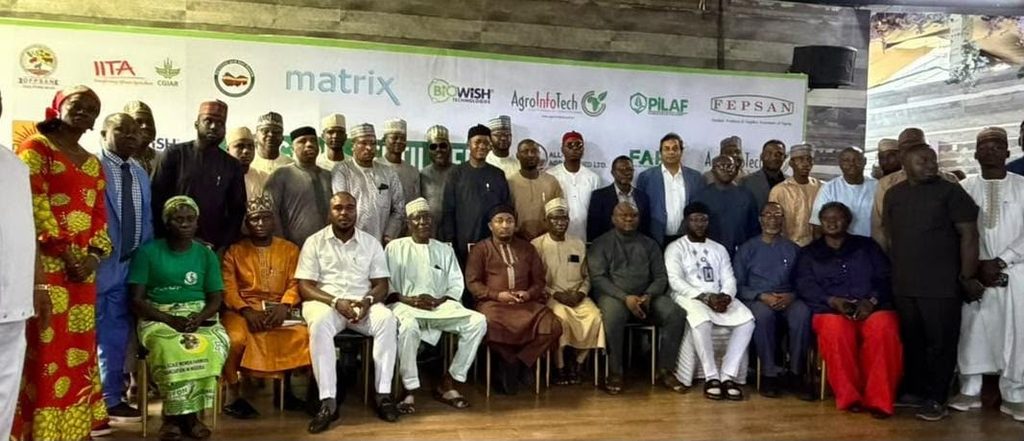
The Minister of Agriculture and Food Security, Senator Aliyu Sabi Abdullahi, has warned that Nigeria’s quest for food security may remain a dream unless the government and farmers prioritise soil health and the proper management of phosphorus, a key nutrient for crop production.
Abdullahi gave the warning on Monday at the Fertilizer Summit on Phosphorus and Food Security in Nigeria, organised in Abuja by the Institute of Agricultural Research and Training (IAR&T) in partnership with OCP Africa.
Represented by the Director of Agricultural Land and Climate Change Management Services, Mr Oshadiya Olanipekun, the minister said productive agriculture depended not only on land, seeds, water and labour but also on the ability of the soil to provide essential nutrients for healthy crop growth.
He identified phosphorus as a critical nutrient for root development, plant growth, seed formation and improved crop yields, lamenting that many Nigerian farmers face challenges accessing it because of declining soil fertility, poor fertilizer practices and inadequate soil-testing services.
The minister said applying fertilizer without understanding the nutrient requirements of the soil could increase production costs, waste resources and reduce farmers’ profits.
He therefore called for a shift from treating fertilizer merely as a commodity for distribution to using it as a strategic agricultural input guided by scientific soil analysis.
He said the Federal Government launched the Nigerian Farmers’ Soil Health Scheme (NFSHS) in October 2025 to improve soil testing and provide farmers with fertilizer recommendations suited to their farmland and crops.
However, he identified inadequate soil-testing facilities across the 774 local government areas, poor soil data, weak institutional coordination, low farmer awareness and the high cost of recommended fertilizers as major obstacles to the scheme’s effective implementation.
Abdullahi announced that a readiness assessment scheduled for 2026 would identify implementation gaps across states, strengthen cooperation among relevant agencies and guide the expansion of the scheme.
He urged stakeholders to translate the findings into practical measures that would improve farmers’ productivity and incomes.
The Executive Director of IAR&T described phosphorus as a neglected but essential link in Nigeria’s food security efforts, warning that years of continuous cultivation without adequate nutrient replacement had left many farmlands deficient in essential minerals.
He explained that phosphorus is vital for plant growth and cannot be manufactured like nitrogen fertilizer, adding that an estimated half of global food production depends on phosphorus fertilizer.
The research institute chief also warned that Nigeria’s dependence on imported fertilizers exposed farmers to international price shocks, noting that Morocco controls roughly 70 per cent of known global phosphate rock reserves.
He called for more efficient fertilizer application through soil testing, improved crop varieties and better nutrient management, while advocating the recycling of phosphorus from animal manure, food waste, slaughterhouse waste and wastewater.
“Food security without phosphorus security does not work,” he said, stressing that Nigeria must improve the way it manages and recycles available nutrients instead of relying solely on imported phosphate resources.
The Vice-Chancellor of Obafemi Awolowo University, Ile-Ife, Professor A. S. Bamire, described sustainable soil fertility management as an investment in national food security and economic stability.
He lamented that soil degradation, deforestation, continuous cultivation and inadequate nutrient replenishment had reduced farmland productivity and farmers’ earnings.
Bamire called for stronger collaboration among government agencies, universities, research institutions, fertilizer producers, farmers and development partners to turn scientific research into practical solutions for Nigerian farmers.
Stakeholders, including FARA, FEPSAN, MATRX, OCP Africa, USCAL, IITA and AFIDA, pledged continued support for efforts to improve fertilizer use and promote sustainable phosphorus management.
Speaking on the importance of the summit, Professor Vincent Aduramigba Modupe, Team Lead of the Technical Committee of the Nigerian Farmers’ Soil Health Scheme, expressed satisfaction with the turnout and said the meeting would help develop practical solutions to the country’s food security challenges.
The summit featured panel discussions involving farmers’ associations, government representatives, researchers and private-sector operators, with participants examining ways to improve soil fertility, expand soil testing and strengthen Nigeria’s fertilizer value chain.
The meeting continues on Tuesday with technical sessions expected to develop actionable strategies for sustainable phosphorus management and improved agricultural productivity.