Delta State Governor, Rt Hon Sheriff Oborevwori, has charged students in tertiary institutions across the state to shun illicit drugs and substance abuse, remain focused on their academic pursuits and pursue their life ambitions with discipline and determination.
The governor gave the charge at Dennis Osadebay University (DOU), Asaba, during the ongoing Drug-Free Delta Campaign being implemented by the state government in partnership with the National Drug Law Enforcement Agency (NDLEA).
Oborevwori, who was represented by the Director-General of the Delta State Bureau for Orientation and Communications, Dr. Wilfred Latimore Oghenesivbe, Esq., said the campaign was a proactive response to growing concerns over the circulation and consumption of illicit drugs across the country, particularly among young people.
He expressed concern over the increasing prevalence of substance abuse among youths, warning that drug addiction could destroy promising lives, derail academic ambitions and undermine the future of individuals, families and society.
According to him, the devastating consequences of hard drugs make it imperative to tackle the menace at every level, including production, distribution and consumption.
The governor described Delta youths as vibrant, productive and forward-looking, urging them not to allow negative peer pressure and other social influences to derail their dreams and aspirations.
He reaffirmed his administration’s commitment to sustained youth engagement, advocacy and sensitisation through the Bureau for Orientation and Communications, in collaboration with the NDLEA, to discourage drug abuse and promote a healthier, safer and more productive society.
“The Drug-Free Delta Campaign is a bold intervention by my administration, reflecting a deliberate commitment to protecting the state’s most valuable asset — its young people.
“Delta’s pioneering approach of taking an organised, government-led anti-drug sensitisation campaign directly to tertiary institutions is yielding positive results, and we are the only state in Nigeria tackling the menace from all fronts. We will not relent until Delta becomes free from hard drugs and substance abuse,” Oborevwori said.
Addressing the students, the State Deputy Commander of the NDLEA, Mr. Silas Omobhude, outlined the grave health, psychological, social and academic consequences of drug and substance abuse.
He warned that the misuse of hard drugs could result in severe mental health complications, including psychosis and, in some cases, irreversible psychological damage. Other consequences include memory loss, impaired judgement, poor concentration, declining academic performance, physical deterioration and addiction.
Omobhude further explained that substance abuse could fuel criminal tendencies, aggression, violence and other antisocial behaviours, thereby exposing young people to avoidable risks and jeopardising their future.
He urged students experiencing drug-related challenges, as well as those concerned about affected friends and family members, to seek professional assistance rather than suffer in silence.
He encouraged them to contact the NDLEA through its toll-free helpline, 080010203040, for guidance and assistance, including access to rehabilitation services.
Earlier, the Vice-Chancellor of Dennis Osadebay University, Prof. Samuel Aghalino, represented by the Dean of Students’ Affairs, Dr. Oghenero Ovhare, reaffirmed the institution’s zero-tolerance policy towards illicit drugs and substance abuse.
He urged students to report cases of drug-related misconduct and other forms of deviance to the appropriate university authorities through the Dean of Students’ Affairs or directly to the NDLEA through its toll-free line, assuring them of the institution’s commitment to maintaining a safe and healthy learning environment.
The Vice-Chancellor commended the Director-General of the Bureau for Orientation and Communications, Dr. Oghenesivbe, and his team for their dedication to taking the Drug-Free Delta message to young people and Deltans in general, noting that no nation could guarantee a bright future when a significant proportion of its youth population was trapped in drug addiction.
He also appreciated Governor Oborevwori for his administration’s efforts in advancing education and expanding access to tertiary education across Delta State’s three senatorial districts.
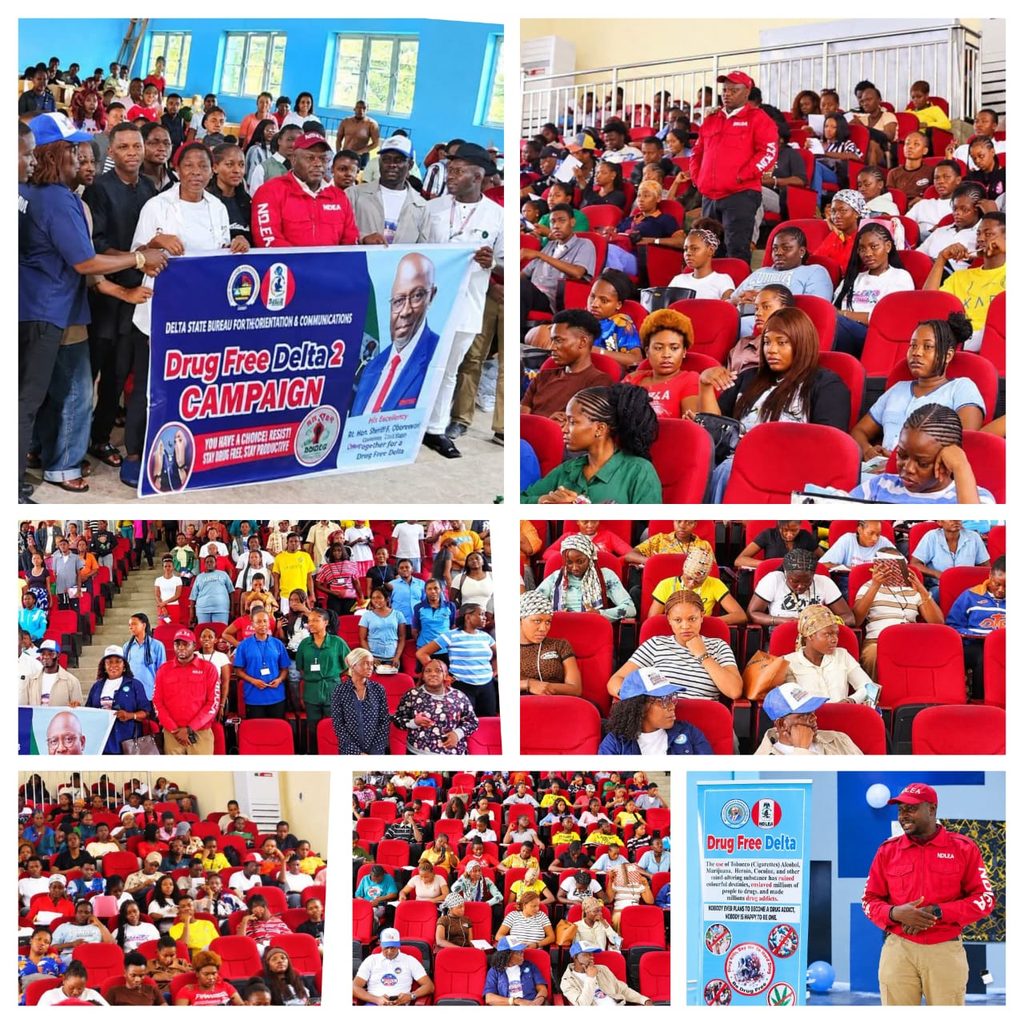
The campaign at Dennis Osadebay University attracted a large turnout, with the Bureau and NDLEA officials addressing students in two major lecture theatres filled to capacity.
The interactive sessions provided students with the opportunity to ask questions, receive practical information on the dangers of substance abuse and learn about available support and rehabilitation services.
The successful engagement further underscored the importance of sustained collaboration between government, educational institutions, parents and relevant agencies in the fight against drug abuse.
By: Sam Erhunmwunsee, Radio Nigeria Asaba