Delta State Governor, Sheriff Oborevwori, has presented a proposed N1.23 trillion budget for the 2027 fiscal year, with 65 per cent of the total expenditure earmarked for capital projects.
Tagged Budget of Sustained Prosperity and Enhanced Growth, the proposal allocates N806.8 billion to capital expenditure, while N430 billion is set aside for recurrent spending.
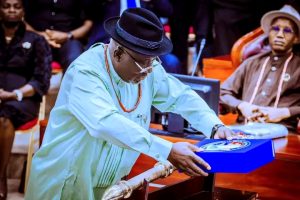
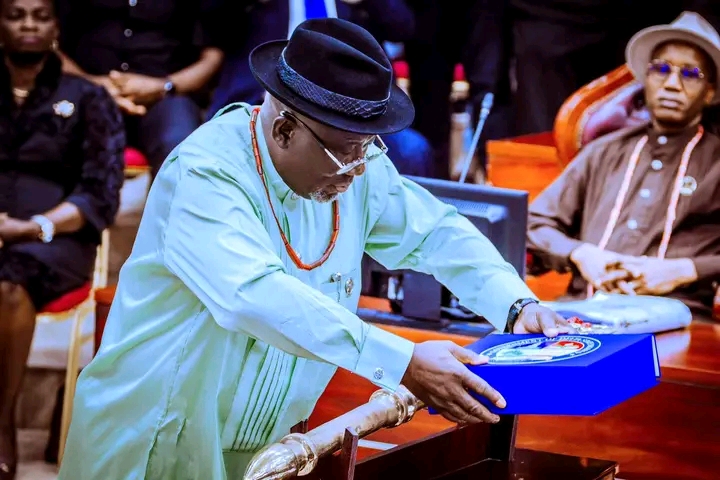
Oborevwori presented the estimates to the Delta State House of Assembly in Asaba for consideration and approval , saying the budget was designed to consolidate ongoing projects, stimulate economic growth and improve the living conditions of residents.
He explained that the proposed budget was N493.01 billion, representing a 28.5 per cent reduction from the N1.729 trillion approved for 2026.
According to him, the reduction was a deliberate move towards realistic revenue and expenditure projections, prudent resource management and stronger fiscal discipline.
The governor identified the completion of ongoing projects, commencement of new investments, consolidation of existing achievements and expansion of social intervention programmes as key priorities of the 2027 fiscal plan.
N320bn for Road Infrastructure
On infrastructure, Oborevwori disclosed that his administration had embarked on 872 road projects and 20 bridges and flyovers since assuming office.
He said the projects covered 2,348 kilometres of roads and 1,871 kilometres of drainage infrastructure across the state.
The governor noted that consultations with communities had shown that roads, bridges and jetties remained among the most pressing needs of residents, particularly those in rural and riverine areas.
To sustain the infrastructure drive, the government proposed N320 billion for the two Ministries of Works to facilitate ongoing projects and new developments.
IGR rises to Projected N283bn
On revenue generation, Oborevwori said Delta State’s Internally Generated Revenue (IGR) had increased from N83 billion in 2023 to a projected N283 billion by December 2026.
He attributed the growth to technology-driven revenue collection, expansion of the revenue base and efforts to block leakages without introducing additional tax burdens.
The governor also disclosed that his administration had repaid N400 billion out of the N463 billion legacy debt inherited, leaving an outstanding balance of N63 billion.
He expressed confidence that the remaining debt would be cleared by the end of the first quarter of 2027.
Education gets N74bn, Healthcare N50bn
In the education sector, the proposed budget provides N74 billion, comprising N10 billion for primary education, N12 billion for technical education, N12 billion for secondary education and N40 billion for higher education.
Oborevwori said the government would continue investing in school rehabilitation, teacher development, digital learning, laboratory facilities and accreditation of academic programmes.
He further disclosed that N10.8 billion had been approved for the rehabilitation and renovation of primary and secondary schools across the state.
For healthcare, N50 billion was proposed to support hospital upgrades, medical supplies, recruitment and improved welfare for healthcare workers.
The governor also highlighted the College of Health Technology, Ovrode, which has enrolled more than 800 pioneer students, as part of efforts to address manpower shortages in the health sector.
N50bn for LGAs, N20bn for capital territory
Other major allocations in the proposal include N50 billion for the 25 local government areas, N20 billion for the Delta State Capital Territory Development Agency and N20 billion for the Warri-Uvwie and Environs Development Agency.
The budget also earmarks N12 billion for energy, N10 billion for urban and physical planning, N5 billion for agriculture and N5 billion for social intervention programmes.
The governor also disclosed that Delta’s Gross Domestic Product (GDP) increased from N14.5 trillion in 2024 to approximately N17.9 trillion in 2025, placing the state as Nigeria’s fifth-largest state economy.
2,155 Energy Projects executed
On electricity and energy development, Oborevwori said his administration had executed 2,155 energy projects, including 90 transformers, 2,003 solar street-lighting projects and 23 power-grid extensions.
He also announced that he had assented to the 13th-month salary bill for public servants, with implementation scheduled to commence in December 2026.
He described the initiative as recognition of workers’ contributions to the state’s development and a measure to ease their financial responsibilities during the festive season.
Government strengthens security architecture
On security, the governor said his administration was deepening collaboration with security agencies to tackle kidnapping, cultism, pipeline vandalism and other criminal activities.
He disclosed that approval had been granted for the construction of 25 police divisional headquarters for state police, while an application had also been made for the recruitment of 1,000 forest guards.
Oborevwori said the 2027 budget would focus on infrastructure development, economic diversification, human capital development, peace and security, with emphasis on ensuring that ordinary Deltans benefited from economic growth.
He subsequently presented the Appropriation Bill to the lawmakers for consideration and passage. The motion was moved by the House Leader, Hon. Emeka Nwaobi, and seconded by Hon. Marilyn Okowa-Daramola.
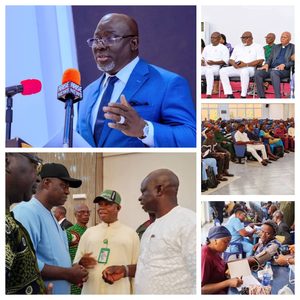
Earlier, the Speaker of the House, Mr Emomotimi Guwor, commended the governor for his administration’s interventions in infrastructure, healthcare, education, social welfare and human capital development.
Guwor particularly applauded the approval of the 13th-month salary for public servants, describing it as a demonstration of the governor’s concern for workers’ welfare.
The Speaker said cooperation between the two arms of government had contributed to the state’s development and assured the governor of the Assembly’s support in considering the proposed 2027 budget.
By: Sam Erhunmwunsee, Radio Nigeria Asaba