
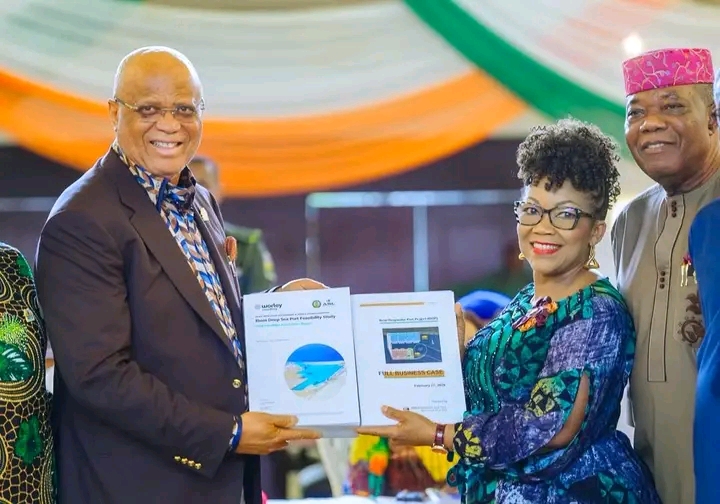
In what many stakeholders describe as a defining moment for Akwa Ibom’s economic future, Governor Umo Eno has reignited confidence in the long-anticipated Ibom Deep Seaport Project, declaring emphatically that the vision—over 20 years in the making—will materialize.
The Governor gave this assurance at the Banquet Hall of Government House, Uyo, during the formal presentation of the project’s feasibility report by the Technical Committee—a milestone widely regarded as a critical step toward actualizing the ambitious maritime infrastructure.
With a tone that blended optimism and resolve, Governor Eno commended the Committee for what he described as a “thorough and professional job,” noting that their work has laid a solid foundation for the next phase of execution. The feasibility report, he said, provides clarity, direction, and renewed momentum for a project that has endured years of delays and shifting priorities.
In a moment of reflection, Governor Eno paid tribute to past leaders whose administrations contributed to the project’s conceptual and developmental journey, including former Governor Victor Attah, Senate President Godswill Akpabio, and immediate past Governor Udom Emmanuel. He stressed the importance of continuity in governance, cautioning against politicizing a project of such magnitude.
“Deep seaport development is not a sprint but a marathon,” the Governor remarked, underscoring the patience, consistency, and collaboration required to bring it to fruition.
He highlighted concrete steps already taken by his administration to fast-track the project, including the funding of a comprehensive feasibility study, preparation of investor-ready documentation, construction of access roads, and execution of geophysical and geotechnical assessments. Additionally, a dedicated project office has been established to coordinate ongoing activities.
Governor Eno also pointed to broader infrastructure strides as evidence of his administration’s integrated development agenda. These include the construction of over 1,300 kilometers of roads, expansion of Ibom Air operations, modernization efforts at the Victor Attah International Airport, and sustained maritime investments in Oron.
Reaffirming his results-driven philosophy, the Governor stated that his administration has “brought all stakeholders to the table” and repositioned the seaport project to the forefront of its development agenda. He charged the Technical Committee to intensify engagement with investors and local communities, emphasizing that the project’s success would translate into widespread economic benefits for the state.
“If we succeed with this project, Akwa Ibom wins,” he declared.
In a forward-looking directive, the Governor tasked the Commissioner for Special Duties with developing targeted training programmes for youths, aimed at building the skilled workforce required for both the construction phase and long-term operations of the seaport.
Presenting the report, Committee Chairman, Mfon Usoro, offered a compelling outlook on the project’s transformative potential. She described the Ibom Deep Seaport as a strategic economic gateway designed to expand Nigeria’s maritime capacity, facilitate trade, and enhance the ease of doing business through a Public-Private Partnership framework.
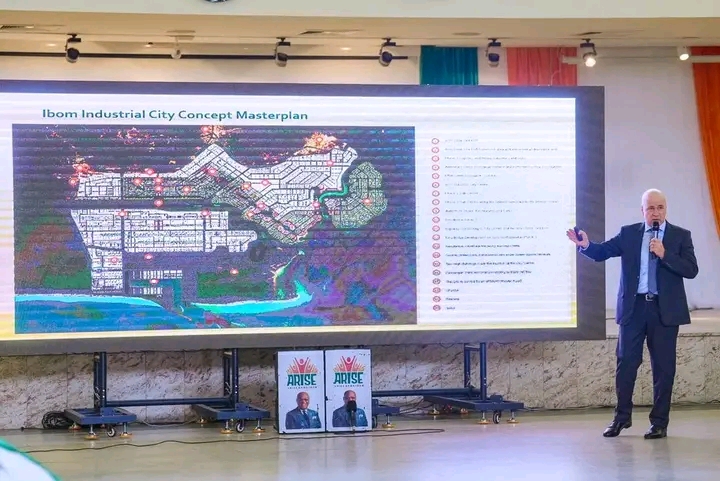
According to her, the port—planned as part of the Ibom Industrial City and backed by a Free Trade Zone designation—has the capacity to evolve into a major transshipment hub and one of the largest deep-sea ports in West and Central Africa. “This is not just a port; it is an economic ecosystem,” she noted, emphasizing its role in driving industrialization and attracting global investment.
Providing further insight into progress made, Mrs. Usoro disclosed that key milestones have already been achieved, including the appointment of programme managers and global transaction advisors, completion of feasibility and due diligence studies, financial modelling, and a transparent international bidding process that has yielded preferred bidders.
She outlined the next phase of the project to include critical infrastructure development such as container terminals, main and secondary breakwaters, and dedicated naval berths. Other essential components include Front-End Engineering Design (FEED), investment roadshows, market studies, access road construction, land acquisition, and regulatory engagements with agencies such as the Nigerian Export Processing Zones Authority and the Nigerian Ports Authority.
While acknowledging the enthusiasm surrounding the project, Mrs. Usoro appealed for patience, noting that deep seaport developments worldwide are complex, capital-intensive, and often span up to two decades from conception to commissioning.
In attendance were representatives of the Federal Ministry of Finance Incorporated and other key federal agencies—an indication of the growing synergy between state, federal, and private sector stakeholders in driving the project forward.
For many observers, Wednesday’s event marks more than just another official ceremony—it signals a renewed determination to transform a long-held aspiration into a tangible economic asset that could redefine Akwa Ibom’s place in Nigeria’s maritime and industrial landscape.