The Nigerian Content Development and Monitoring Board, NCDMB, has unveiled a new digital Nigerian Content Fund Compliance Certificate Portal, designed to cut certification delays, improve transparency and enhance access to financing for indigenous oil and gas companies.
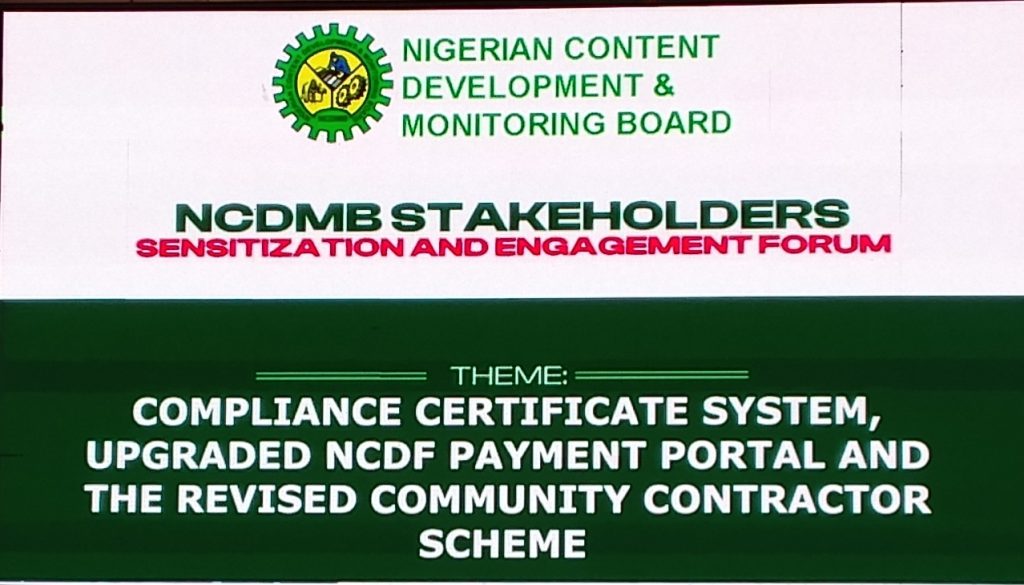
The portal was unveiled in Uyo, Akwa Ibom State, during the NCDMB Stakeholders Sensitisation Programme on the Compliance Certificate System, upgraded Nigerian Content Development Fund payment portal and revised Community Contractor Scheme.
Unveiling the portal, the Executive Secretary, Engr Felix Ogbe, represented by the Funds Manager, Mr Emmanuel Youssef, said the initiative goes beyond technology, describing it as part of efforts to promote ease of doing business, digital transformation and accountability in the oil and gas industry.
“With the launch of this portal, compliance becomes faster, simpler, and more transparent.”
Engr Ogbe explained that under the Nigerian Oil and Gas Industry Content Development Act, one per cent of every applicable upstream contract is deducted at source and paid into the Nigerian Content Fund.
He said the compliance certificate serves as proof that companies have met their statutory obligations and is an important requirement for accessing the fund.
According to the, Nigerian content has risen to 60 per cent, while more than 400 million US dollars has supported over 130 indigenous companies, helping to address the persistent challenge of access to finance.
He also highlighted interventions such as Project 100 and a 100-million-dollar equity investment scheme as initiatives designed to strengthen indigenous capacity and promote sustainability in the sector.
The Board said the new portal will enable companies to apply online without physical visits or paperwork, receive instant status updates and allow regulators to verify compliance in real time.
“The portal will cut certificate processing time from weeks to days.”
The development, iEngr Ogbe said, will provide a single digital record that investors and lenders can rely upon, while enabling compliant companies to obtain certification faster and unlock financing opportunities for projects capable of creating jobs and expanding Nigeria’s oil and gas value chain.
At the sensitisation programme, stakeholders were also taken through the Nigerian Oil and Gas Industry Content Joint Qualification System, NOGIG JQS, described as the central database for the capacities and capabilities of companies and individuals operating in the oil and gas industry.
The system, participants were told, is the platform for Nigerian content registration and qualification and is also used to rank companies according to their capacities and competencies.
Companies seeking registration are required to submit a letter of intent and relevant statutory documents before being issued login credentials, after which they must update their profiles with information on their services, equipment, assets, personnel and previous industry experience.
Mr John Efridi stressed that registration on the NOGIC QS is only the first step, noting that companies must provide accurate and comprehensive information before obtaining their Certificate of Registration and subsequently applying for the Nigerian Content Development Certificate.
Companies were equally advised to use corporate email addresses for their accounts instead of personal emails or third-party handlers, in order to protect account ownership and ensure continuity when employees leave the organisation.
“The best thing you can do as a company is to make sure that whoever is handling your accounts is a staff of the company.”
The programme also provided a platform for financial institutions to explain financing opportunities available to indigenous businesses through partnerships with NCDMB.
The Bank of Industry noted that access to finance remains a major challenge for indigenous companies, stressing the importance of understanding funding requirements and the application and appraisal process.
NEXIM Bank also reaffirmed its commitment to supporting Nigerian oil and gas service providers through financing solutions aimed at business expansion, market access and increased participation in the global oil and gas value chain.
The financial institutions urged participants to take advantage of the sensitisation programme by engaging with relevant agencies, understanding the new systems and exploring available financing mechanisms.
The NCDMB, on its part, called for collective adoption of the digital reforms, stressing that effective Nigerian content development requires continuous stakeholder engagement, collaboration and capacity building.
The Board said the reforms represent a shift from regulation focused solely on enforcement to one that also enables indigenous businesses to access opportunities, financing and greater participation in the oil and gas industry.
The programme brought together industry operators, indigenous service companies, government agencies, financial institutions and other stakeholders from Akwa Ibom, Cross River, Abia and neighbouring states.