…To train 93 indigenes in underwater welding, sustain labour harmony and deepen civic awareness across 31 LGAs
The Akwa Ibom State Government says it is strengthening manpower development, industrial peace and grassroots enlightenment as part of efforts to expand employment opportunities, promote peaceful coexistence and improve citizens’ understanding of government policies and programmes.
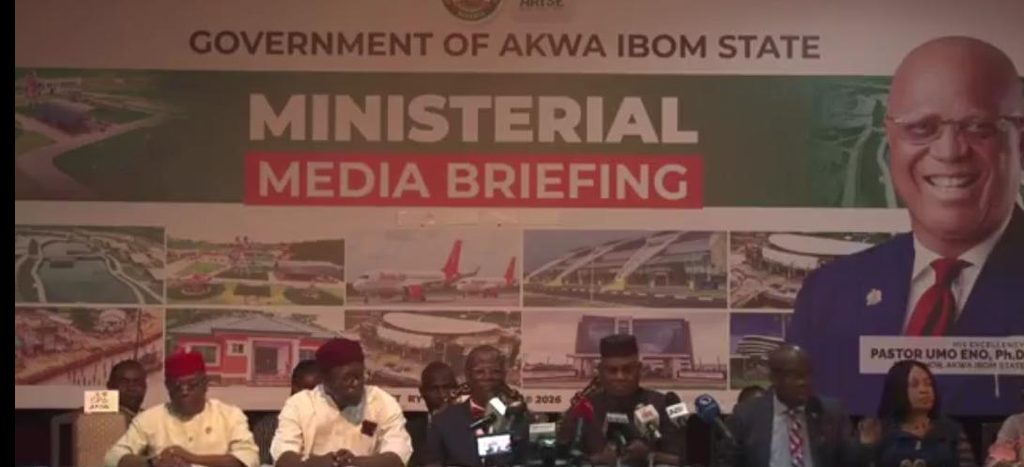
The Commissioner for Labour and Manpower Planning, Elder Ikoedem Ekong, and the Special Adviser to the Governor on Political and Social Reorientation, Barrister Kufre Udosen, disclosed this during a ministerial media briefing in Uyo, where they presented the achievements and ongoing interventions of their respective agencies since the inception of Governor Umo Eno’s administration on May 29, 2023.
A major highlight of the briefing was the planned six-month underwater-welding training programme for 93 Akwa Ibom indigenes. Each of the state’s 31 local government areas is expected to nominate three candidates for the initiative, which officials said would be sponsored by a company identified during the briefing as Sterling Global.
Elder Ekong said the programme formed part of the state government’s engagement with the company and its efforts to create opportunities for indigenes to acquire specialised technical skills.
The Commissioner explained that the initiative is expected to broaden access to technical training in a specialised field, leading to employment for the participants.
On manpower development, Elder Ekong disclosed that the ministry had facilitated annual skills training for 310 indigenes in collaboration with the Dakada Training Centre. He said the programme was designed to equip beneficiaries with skills for productive engagement and self-reliance.
He explained that the ministry’s responsibilities extended beyond employment-related interventions to include the protection of workers’ rights, workplace inspections, mediation of industrial disputes, manpower development and the promotion of constructive relationships among government, employers and organised labour.
The Commissioner said the ministry had sustained dialogue and consultations with trade unions, employers and other stakeholders to resolve labour-related grievances and prevent disputes from escalating into industrial action capable of disrupting productivity and economic activities.
Among the unions and associations whose issues had received the ministry’s attention were the Academic Staff Union of Universities, the Judicial Staff Union of Nigeria, the Nigerian Union of Agricultural and Allied Employees, and the Parliamentary Staff Association of Nigeria.
The commissioner also highlighted the ministry’s intervention in the settlement of outstanding workers’ entitlements, including the facilitation of ₦150 million in gratuities and other entitlements for former workers of Akwa Palms Limited, a company that had been closed for more than 17 years.
He further disclosed that the ministry facilitated the payment of ₦180 million in six-month salary arrears to workers of St. Gabriel’s Coconut Company, while the state government approved an additional two months of salary payments for the affected workers.
According to him, the ministry also conducts inspections of industrial establishments to promote compliance with labour laws, applicable regulations and decent working conditions, while building the capacity of labour leaders in negotiation, dispute resolution and industrial relations.
The commissioner said the government’s commitment to workers’ welfare was also reflected in the implementation of an ₦80,000 minimum wage for civil servants from November 1, 2024.
In a related development, the Special Adviser on Political and Social Reorientation, Bar. Kufre Udosen said the bureau had intensified grassroots enlightenment across the state’s 31 local government areas to promote civic responsibility, peaceful political participation, positive social values and a better understanding of government policies and development programmes.
Bar. Udosen described the bureau as a strategic link between government and the people, explaining that its mandate included political awareness, civic education, democratic participation, peaceful coexistence and the promotion of responsible citizenship.
He said the bureau had engaged communities, religious institutions, traditional leaders and other stakeholders to sensitise residents on government interventions and provide platforms through which citizens could communicate their concerns to the authorities.
According to him, the bureau’s outreach programmes also encourage residents to identify and understand projects located in their communities, thereby promoting public awareness, community ownership and constructive feedback on government activities.
The special adviser listed radio programmes, jingles, newspaper publications, billboards and community sensitisation exercises among the communication channels employed to promote civic education and positive social values.
He attributed the peaceful conduct of the 2025 party primaries in the state, in part, to sustained political enlightenment and engagement with citizens on responsible political participation.
Bar Udosen stressed that effective governance required more than policy formulation and implementation, noting that citizens must also understand government initiatives, appreciate their relevance and participate constructively in community development.