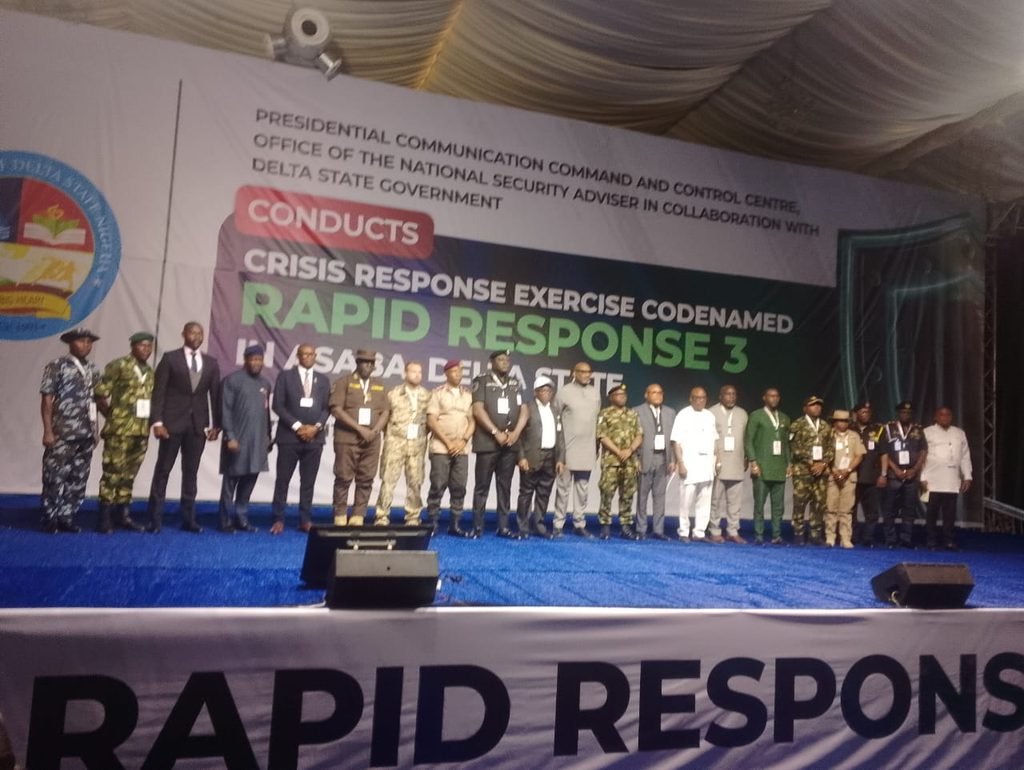
Hundreds of security personnel including service chiefs from various security agencies converged on Asaba for a five-day Crisis Response Simulation exercise codenamed 2026 Rapid Response 3 organized by the Office of the National Security Adviser .
The exercise is to test the preparedness, responsiveness and inter-agency coordination of security and emergency management stakeholders in handling complex security situations.
Director, Presidential Communication Command and Control Centre, Office of the National Security Adviser, Rear Admiral Ayo-Vaughan Olukayode, who spoke during the exercise, said the initiative was designed to validate existing crisis response plans, test established procedures, identify capability gaps and strengthen coordination among relevant agencies.
He said the exercise would provide participating agencies with an opportunity to test their capacity to respond promptly and effectively to simulated emergencies, while assessing communication, information-sharing and command-and-control arrangements.
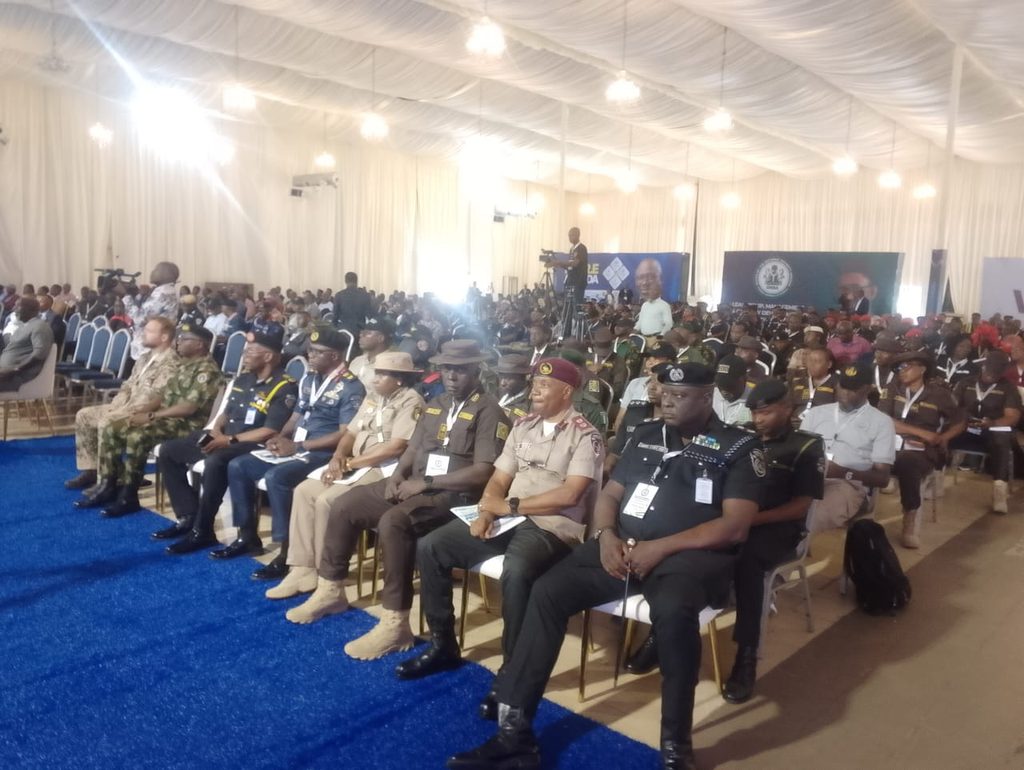
According to him, Rapid Response 3 will also help identify challenges and areas requiring improvement in the national crisis response architecture, while enhancing the capacity of personnel through practical exposure to coordinated, multi-agency operations.
He explained that the exercise would be conducted as a full-scale crisis response involving three levels of command — Gold, Silver and Bronze — with two scenarios to be conducted sequentially.
Rear Admiral Ayo-Vaughan said the first scenario would take place at the Asaba International Airport, while the second would be conducted along the Benin-Asaba Expressway.
He directed participants to treat all incidents as simulated and respond strictly in accordance with established operational procedures, contingency plans and exercise directives.
The Director stressed that the Gold, Silver and Bronze command structure would remain operational throughout the exercise to ensure effective strategic, operational and tactical coordination.
He urged participating Ministries, Departments and Agencies (MDAs) to maintain clear reporting channels and ensure that information was transmitted through the appropriate command structure.
He further cautioned participants to distinguish between genuine emergencies and exercise-related incidents, directing that any real-world emergency be immediately reported to the exercise control.
Emphasising safety as a command priority, Ayo- Vaughan warned that no participant should undertake any action capable of endangering personnel, members of the public, infrastructure or equipment.
He stressed that the exercise was entirely simulated and that live ammunition, explosives or other hazardous materials must not be introduced into the exercise environment.
The ONSA official also underscored the importance of effective communication, discipline and professionalism, urging all participating agencies to maintain reliable communication with their respective command elements and exercise control.
He noted that public sensitisation measures, including SMS and radio messages, had been deployed to prevent misunderstanding or panic among residents of Asaba and surrounding communities.
He said the objective of the exercise was not to showcase the superiority of any individual agency, but to test the effectiveness of the whole-of-government crisis response mechanism.
“Cooperation, timely information sharing and effective coordination” should therefore remain the guiding principles throughout the exercise, he said.
He expressed appreciation to the Delta State Government and people of the state, particularly Governor Sheriff Oborevwori, for accepting to host the exercise in Asaba.
In a remark delivered virtually, the United Kingdom reaffirmed its commitment to supporting Nigeria’s efforts to strengthen crisis management and counter-terrorism capabilities, saying the Rapid Response 3 exercise will provide valuable lessons for improving the country’s emergency response architecture.
The UK Counter-Terrorism Lead, Colonel Ian Tyler, who spoke on behalf of the British High Commission during the exercise in Asaba, said Rapid Response 3 would put into practice the training delivered to Nigerian stakeholders over the past two years, particularly the latest training conducted in July.
“Participants should not be overly concerned about mistakes or setbacks during the exercise, stressing that the chaotic nature of crises makes practical simulation essential to effective preparedness”
“This is the purpose for exercising in a safe, planned environment where we can highlight any possible capability gaps,”
“Effective communication will be critical to the success of the exercise, particularly in ensuring that the right information reaches the Gold Command Team in Abuja for appropriate decision-making.
“I commend Nigeria for the progress made in developing and applying crisis management structures, noting that the country had “come a long way in a short time.” Tyler stated.
The UK official said the lessons identified during Rapid Response 3 would be crucial to improving future responses to complex emergencies.
Delta State Governor, Sheriff Oborevwori represented by the Secretary to the State Government, Doctor Kingsley Emu commended the Office of the National Security Adviser for the decision to host the Rapid Response 3 in Asaba, and reaffirmed the cooperation of the government to ensure a successful exercise.
Governor Oborevwori noted with delight the efforts of the administration of President Bola Tinubu in tackling security challenges, emphasizing the need for Nigerians to support security agencies.
“As a state, we are prepared to host the simulation exercise for rapid response 3 to bring back the consciousness of multi-agency synergy and interaction to the grassroots.Team work is successful when members see themselves as one without significant division”, Oborevwori said