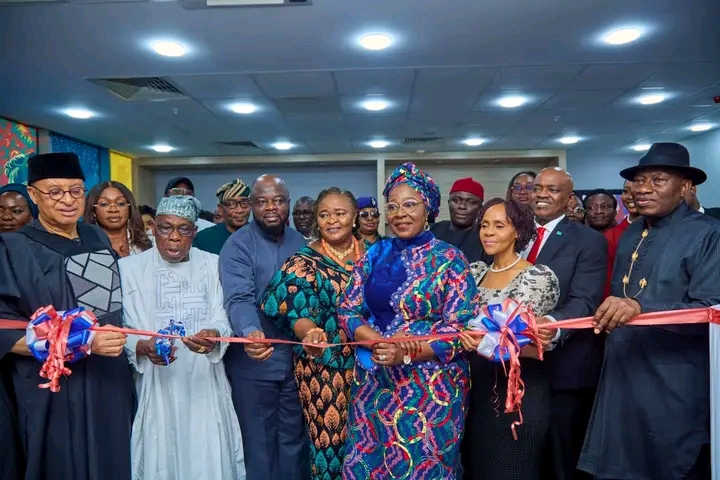
Former leaders urge C54 News to challenge negative stereotypes, promote African enterprise and strengthen continental integration
Former Nigerian Presidents Olusegun Obasanjo and Goodluck Jonathan, alongside former Botswana President Dr Mokgweetsi Masisi, have called on African media organisations to reclaim the continent’s narrative by telling its stories through authentic African perspectives, credible journalism and balanced reporting.
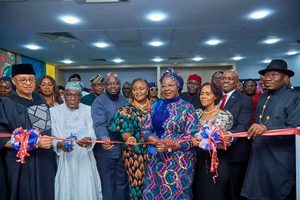
The former leaders made the call at the unveiling of C54 News Global Streaming Dome and the inaugural live broadcast of the pan-African news platform in Uyo, Akwa Ibom State, describing the initiative as a significant step towards correcting distorted perceptions of Africa and amplifying the continent’s achievements, aspirations and development opportunities.
They stressed that Africa must move beyond being the subject of narratives shaped predominantly by external interests to becoming an active author of its own history, projecting its people, cultures, innovations and economic potential without concealing the challenges confronting the continent.
Former President Obasanjo, who commended the founders of C54 News for addressing what he described as a missing link in Africa’s media landscape, maintained that the responsibility for telling Africa’s story rests primarily with Africans themselves.
He observed that, for too long, the continent had either outsourced its narrative or allowed others to appropriate and interpret its experiences through perspectives that frequently failed to reflect the realities of African societies.
According to him, when Africans surrender the responsibility of telling their own stories, those stories are inevitably presented through the interests and interpretations of others.
Obasanjo recalled his experience at an emancipation event in Barbados, where he became concerned about reports that some American schools were teaching versions of history that downplayed or denied the transatlantic slave trade.
The former President said the experience inspired him to initiate a book titled Lest We Forget, bringing together contributions from experienced scholars to preserve historical truth and guard against attempts to erase the experiences of enslaved Africans.
He emphasised that remembering the transatlantic slave trade was not merely about seeking financial reparations but also about securing acknowledgement of historical injustice, demonstrating remorse and ensuring that such atrocities never happen again.
Obasanjo urged C54 News to extend its coverage beyond the continent’s 54 countries to what he described as Global Africa, including people of African descent whose histories and experiences are integral to the wider African identity.
He also challenged African leaders to critically examine inherited economic assumptions and development models, arguing that the continent needed a stronger understanding of its own interests, institutions and historical experiences.
For the former Nigerian leader, C54 News should use its news, documentary and data platforms to educate citizens, expose historical distortions and help African leaders make informed decisions about the continent’s future.
Former President Jonathan, in his remarks, described the emergence of C54 News as timely, particularly as Africa continues to contend with what Nigerian author Chimamanda Ngozi Adichie calls the danger of a single story.
He noted that international media coverage had often presented Africa predominantly through images of conflict, hunger, disease, insecurity and destruction, leaving insufficient room for the continent’s innovation, entrepreneurial energy, cultural richness, expanding markets and immense human potential.
Jonathan, however, cautioned that reclaiming Africa’s narrative must not translate into propaganda or the suppression of uncomfortable truths.
He maintained that African media organisations must report the continent’s achievements confidently while holding governments, businesses and public institutions accountable for corruption, insecurity, injustice, poor governance and other obstacles to development.
The former President called on C54 News to uphold accuracy, fairness, professional ethics and editorial independence, while combating misinformation and amplifying the voices of young people, women and underserved communities.
He added that the platform’s success should be measured not simply by its technological capacity or international reach, but by the quality of its journalism, its contribution to democratic development and the trust it earns from the public.
In his keynote address, former Botswana President Dr Mokgweetsi Masisi described the unveiling as an important milestone in Africa’s broadcasting and communications landscape, noting that the continent had never lacked stories, talent, wisdom or creativity.
Masisi recalled Africa’s longstanding storytelling traditions, through which elders passed knowledge, history, values and cultural identity to younger generations through folktales, music, dance, language and other forms of oral expression.
He argued that the challenge was not the absence of African stories but the need to build effective platforms through which those stories could travel across national borders and reach global audiences.
According to him, the dominance of externally shaped narratives has often placed greater emphasis on Africa’s failures than its achievements, undermining confidence and reinforcing perceptions of superiority elsewhere.
Masisi called for investments in digital infrastructure, reliable electricity, internet connectivity, research and development, education and technological innovation to enable Africa to compete effectively in the global information economy.
He stressed that a connected continent must mean more than modern broadcasting facilities in major cities; it must also enable rural students to access knowledge, farmers to obtain useful market information and small businesses to reach customers beyond their immediate environments.
The former Botswana President further advocated greater opportunities for young people and women to participate in media, technology, enterprise and decision-making, describing them as creators and innovators whose contributions were essential to Africa’s future.
He urged C54 News to build a reputation founded on accuracy, fairness, independence and integrity, noting that technological reach alone could not guarantee credibility.
Earlier, Professor Pat Utomi described the platform as an opportunity for Africans to begin documenting their own experiences and correcting narratives that have influenced international perceptions of the continent.
Citing the African proverb popularised by the late Nigerian novelist Chinua Achebe, that until the lions have their own historians, the story of the hunt will always glorify the hunter, Utomi said Africa had for too long been described more by others than by its own people.
He argued that negative perceptions of African countries could carry tangible economic consequences, including higher borrowing costs, reduced investor confidence and missed opportunities for intra-African trade.
The political economist maintained that credible information about African markets, businesses and investment opportunities would help build confidence, strengthen commercial relationships and encourage economic cooperation across borders.
Utomi commended Akwa Ibom State for providing a home for the initiative, noting that the state had supported the project from its early stages, when it existed largely as an idea.
He expressed optimism that a continental media network could improve communication among African countries and help create the confidence required for greater trade, investment and shared prosperity.
Representing Governor Umo Eno, the Deputy Governor of Akwa Ibom State, Senator Akon Eyakenyi, welcomed the management and staff of C54 News, describing the establishment of the platform in Uyo as an important opportunity to strengthen the state’s visibility internationally.
She said Akwa Ibom had deliberately positioned itself as a tourism destination, citing its road network, aviation services, hospitality, emerging tourism assets and investments in health, commerce and infrastructure.
Eyakenyi listed the forthcoming ARISE Palm Resort, the International Convention Centre, Ibom International Hotel, ARISE Shopping Centre, Ibom International Hospital and Ibom Model Farm among facilities expected to strengthen the state’s tourism and investment appeal.
She said the state government was committed to maintaining a media-friendly environment and looked forward to sustained collaboration with C54 News in projecting Akwa Ibom’s development, opportunities and distinctive identity to the world.
The Deputy Governor expressed confidence that the platform would help place the state more prominently on the global map, while inviting visiting dignitaries and other guests to experience its tourism and development assets.
The unveiling of C54 News therefore represents more than the commissioning of a broadcasting facility. It raises a fundamental question about who controls the telling of Africa’s story, whose experiences shape global understanding of the continent and how information can be harnessed to promote development.
For the continent to secure a more balanced place in global conversations, African storytelling must combine historical honesty with contemporary evidence, cultural authenticity with professional journalism, and the celebration of achievements with the courage to expose failures.
With its proposed coverage of all 54 African countries through news, documentaries and data, C54 News has an opportunity to connect African societies, showcase home-grown solutions and improve the flow of information needed for trade, investment and democratic accountability.
Ultimately, the platform’s enduring significance will depend on whether it enables Africans to see themselves more clearly, understand one another more deeply and engage the rest of the world on the strength of their own verified experiences.
As the former leaders emphasised, Africa does not need a manufactured image of perfection. It needs the freedom, capacity and credibility to tell its complete story—its struggles, its resilience, its achievements and its possibilities—in its own voice.